Champion
Inventor of Reverse Weave. Champion's Running Man logo, woven tags, and single-stitch construction date its sweatshirts across the athletic era.

- Origin
- USA
- Founded
- 1919
- Category
- Athletic & Streetwear
- Documented eras
- 8
How Champion labels evolved over time. Match the markers below against the tag in hand to place a garment in its era.
1940–1949
Champion Knitwear Company
The full name — Champion Knitwear Company — is printed on the tag. The logo has a small runner crossing a finish line on the left. The wordmark is blocky, early, and looks almost nothing like the modern font.

How to spot it
The full "Champion Knitwear Company" name, a blocky early wordmark, and a tiny runner crossing a finish line.
Value signal
The oldest Champion branding there is — pre-modern and rarely seen, so anything from this decade is a serious find.
1950–1959
Processed Sportswear Rebrand
The runner emblem went blue early in the decade. By the late '50s, "Knitwear Company" was gone, replaced by "Processed Sportswear," and the font got more script-like. Two pretty different looks within one decade — if you're trying to get specific, the text style matters.

How to spot it
A blue runner emblem; "Processed Sportswear" wording and a more script-like font mark the late-'50s end of the decade.
Value signal
Still early and uncommon. The switch to "Processed Sportswear" lets you split the decade in two, which matters to buyers of older Champion.
1960–1969
Runner Inside the C
Watch for the runner emblem tucked inside the C. The text stayed blocky, so font alone won't date these — that C detail is your real anchor.

How to spot it
The runner emblem tucked inside the letter C — the text is still blocky, so the C is the real tell.
Value signal
1960s Champion is well into collectible territory — confirm the date with the runner-in-C before you trust it.
1970–1979
The Script Logo Arrives
The script logo most people know showed up here: the C with the line through it, offset on a colored background. That combination is basically a timestamp.

How to spot it
The familiar script C with a line struck through it, offset on a colored background.
Value signal
The script logo is what vintage Champion buyers chase — a clean '70s tag is a strong, easily dated seller.
1980–1989
Script in Blue, Synthetic Blends
Script logo, now in blue. The more useful tell: synthetic blends start appearing in the material list. Cotton-only tags skew earlier; a blend listed out is an '80s signal.

How to spot it
The blue script logo, with synthetic blends listed in the material content.
Value signal
'80s blue-script Reverse Weave is prime vintage streetwear — the cotton-vs-blend tell helps place a piece within the decade.
1990–1999
Heavy Tags & Stitched Text
Two things to look for — a heavier, slightly shiny tag material, or thick tags with pixelated stitched text. That stitched style was pretty much exclusive to this era.

How to spot it
A heavier, slightly shiny tag — or a thick tag with pixelated stitched lettering.
Value signal
The stitched-text tag is exclusive to this decade, so it dates a piece reliably — and '90s Champion still moves well.
2000–2009
Authentic Athletic Apparel
Tags got longer, with more care info. "Authentic Athletic Apparel" shows up as a tagline. The C emblem starts appearing on its own more, less as a supporting element and more as the main logo.

How to spot it
A longer tag with extra care info and the "Authentic Athletic Apparel" tagline.
Value signal
Plentiful and lower-value on its own — worth more for a strong graphic or collaboration than for the tag.
2010–2019
Multi-Language Tags & Websites
Sizing in multiple languages is standard by now. The fastest giveaway for anything recent: a website printed on the tag. The C and script logo also start appearing together more consistently.
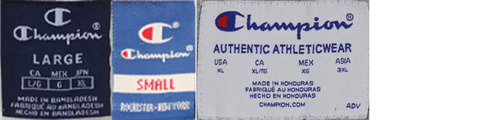
How to spot it
Multi-language sizing and — the dead giveaway — a website address printed on the tag.
Value signal
Modern and common, with little vintage premium. The printed website is your fastest "this is recent" check.