Fruit of the Loom
One of the oldest US textile brands and a workhorse graphic-tee blank. Its woven-to-printed tag evolution and stitch type date countless 80s and 90s tees.
- Origin
- USA
- Founded
- 1851
- Category
- Blank Tag
- Documented eras
- 7
How Fruit of the Loom labels evolved over time. Match the markers below against the tag in hand to place a garment in its era.
1930–1939
1930s
These almost never surface. If you do find one, the tag information is sewn directly into the fabric — there's no printed label.

- Tag information sewn directly into fabric
- No printed label
- Extremely rare to find
How to spot it
Tag sewn into fabric — no separate printed label exists.
Value signal
Exceptionally rare — a genuine collector find. If the information is sewn directly into the fabric, the piece itself is likely the rarest FOTL garment you'll ever encounter.
1950–1959
1950s
Look for the logo on a white rectangle. Sizing, fabric composition, and country of manufacture all start appearing in this era. Late in the decade, logos switched from sewn to printed — which meant the artwork could finally match the actual company logo accurately.

- Logo on white rectangle
- Sizing, fabric composition, and country of manufacture present
- Early decade: logo is sewn
- Late decade: logo switched from sewn to printed
How to spot it
Logo on white rectangle; late-decade shift from sewn to printed logo.
Value signal
Scarce and increasingly sought after. Sewn-logo versions command more than printed ones; either way these surface rarely and are worth pulling.
1960–1969
1960s
The logo text sits below the emblem now. Sizing runs at the top in both text and number. Care instructions show up for the first time. One clean rule: if everything on the tag is printed rather than sewn, you're in the '60s or later.

- Logo text sits below the emblem
- Sizing at top in both text and number format
- Care instructions appear for the first time
- Fully printed tag (nothing sewn)
How to spot it
All-printed tag; logo text below emblem; sizing in both text and number at top.
Value signal
Uncommon. The all-printed tag is a clean dating tool; value is driven by garment type and condition rather than the blank itself.
1970–1979
1970s
Tags are more uniform. Care info is almost always present. Sizing still runs in both number and letter format — that dual system is your signal you're not yet in the '80s.

- More uniform tag design
- Care info almost always present
- Sizing in both number and letter format
How to spot it
Dual sizing format (number and letter) — definitive signal you're pre-1980s.
Value signal
Moderate. The dual sizing is a reliable dating anchor for confirming 70s graphics. Value lives in the graphic, not the blank.
1980–1989
1980s
The late '70s logo update starts showing up on tags. The fastest tell: the grapes are noticeably more vibrant. Some tags also switched to polyester fabric around this time.
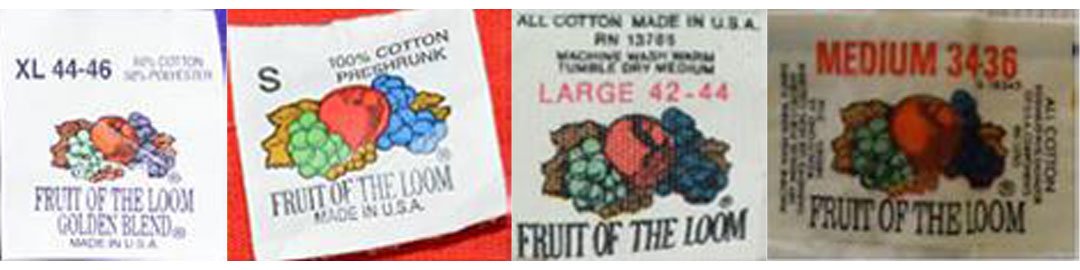
- Late '70s logo update visible on tags
- Grapes noticeably more vibrant — fastest visual tell
- Some tags switched to polyester fabric
How to spot it
Vibrant grapes — fastest tell for dating this era.
Value signal
Strong alongside a desirable graphic. The vibrant grapes confirm an 80s blank — the sweet spot for single-stitch tee collectors.
1990–1999
1990s
Nearly all tags are polyester and white, usually paired with a second tag behind them packed with care info — sometimes in multiple languages. Number sizing is gone; letters only. Some tags carry an American flag at the bottom. Mid-to-late '90s: watch for a logo in a black frame with sizing in a black box underneath — a distinct look. Production started shifting offshore to places like Honduras, though American components were still in the mix.
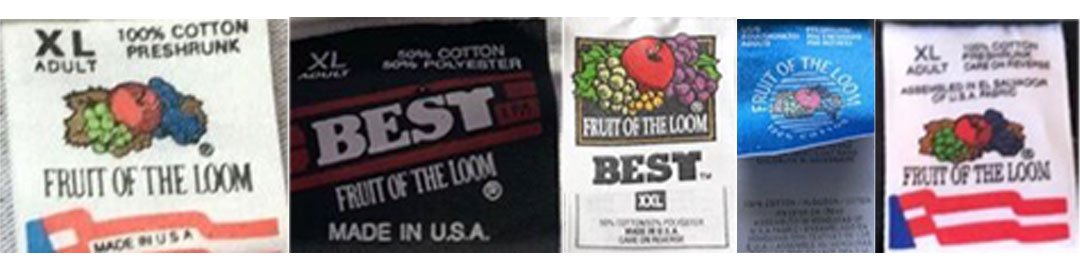
- Polyester white tags
- Second care tag behind the main tag, sometimes in multiple languages
- Letter-only sizing (no numbers)
- Some tags carry an American flag at the bottom
- Mid-to-late '90s: logo in a black frame with sizing in a black box
- Production shifting offshore to Honduras
How to spot it
Letters-only sizing; white polyester with second care tag; mid-late '90s: distinctive black-framed logo.
Value signal
Common. The black-frame logo variant is slightly more collectible; otherwise the blank adds little premium — the graphic carries the value.
2000–2009
2000s
The 2003 logo is obvious once you see it — "of the" is visibly squeezed between "Fruit" and "Loom." Tags are large polyester squares. If the logo looks cramped in the middle, you're post-2003.
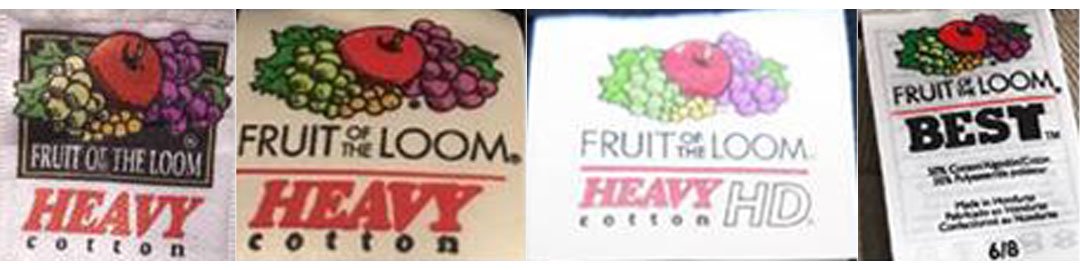
- "of the" visibly squeezed between "Fruit" and "Loom" (2003 redesign)
- Large polyester square tags
How to spot it
Cramped "of the" text in center — definitive post-2003 identifier.
Value signal
Very common; no vintage premium on the blank. Useful for dating purposes only — pass unless the graphic is exceptional.