Gucci
Florentine leather house founded by Guccio Gucci. The logo's journey — crest, script, interlocking-G — and the shift from white to black tags do the dating.
- Origin
- Italy
- Founded
- 1921
- Category
- High Fashion
- Documented eras
- 6
How Gucci labels evolved over time. Match the markers below against the tag in hand to place a garment in its era.
1950–1969
Crest-Logo Sewn-In Tags
The earliest tags use the original Gucci crest, often with a script logo beside it — white, usually rectangular, sewn in all the way round.
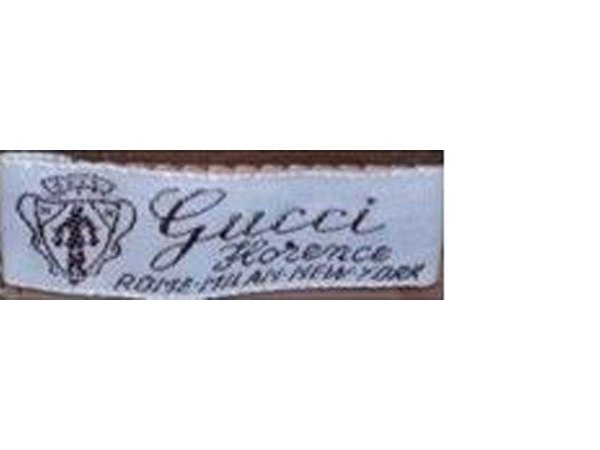
- The earliest tags we could find use the original logo with the Gucci crest
- Many of these early tags would have the emblem logo with a script version of the logo beside it
- These tags were white and often rectangular
- They are mostly sewn in all the way around the tag
- Gucci has a long history of manufacturing in Italy, so whilst some tags may make reference to New York or other fashion hubs, they will nearly always say ‘Made in Italy’
How to spot it
The heraldic crest logo, usually with 'Made in Italy'.
Value signal
Rare and collector-grade; mid-century Gucci seldom surfaces while thrifting.
1970–1979
Angled Script, First Composition Tags
The crest faded out; the script logo was often angled, sometimes with the first 'G' of Guccio, and basic composition and wash wording appeared. Tags were white or yellow.
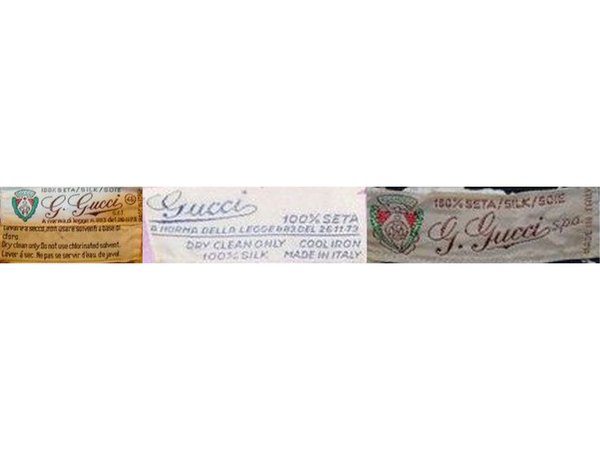
- The use of the emblem on tags became increasingly infrequent throughout the 1970s
- The Gucci script logo from this time also became angled more often, sometimes with the first G of Guccio Gucci included
- Tags also started to include information about material composition and basic washing warnings
- The majority of these tags were white or yellow, and the shape began varying more often between square and rectangles
How to spot it
An angled script logo on a white or yellow tag.
Value signal
Highly desirable; genuine 70s Gucci is strong collector territory.
1980–1989
New Capital Logo Introduced
A new capital-letter logo arrived on tags, a few still showing the crest; sizing began appearing, often as measurements rather than letters. Tags stayed white.
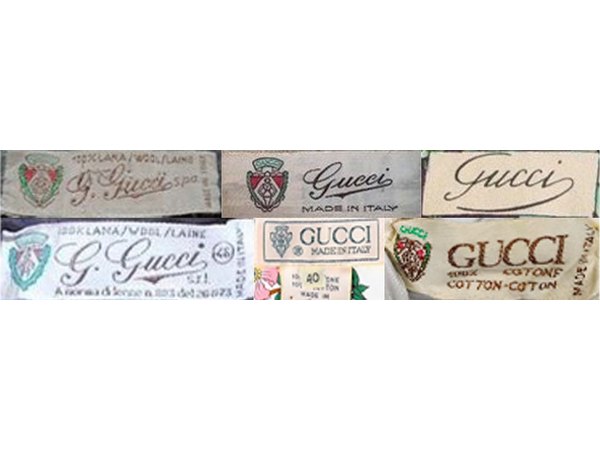
- A few of the tags from the 1980s included the crest logo
- However, a new logo was introduced around this time on tags
- It became more common for them to include sizing information, often in the form of measurements instead of the letter sizing most of us are used to nowadays
- The new logo used capital letters so is easily distinguishable
- Although the two G’s logo was introduced around this time, it was mostly used outwardly on designs instead of directly onto tags
- These tags remained white
How to spot it
A capital-letter logo (the two-G mark stayed mostly off tags).
Value signal
Strong; 80s Gucci has a steady, authentication-driven market.
1990–1999
Black Rectangle Tags
The new logo fully replaced the crest on simple black rectangular tags; all detail beyond the name moved to wash tags.
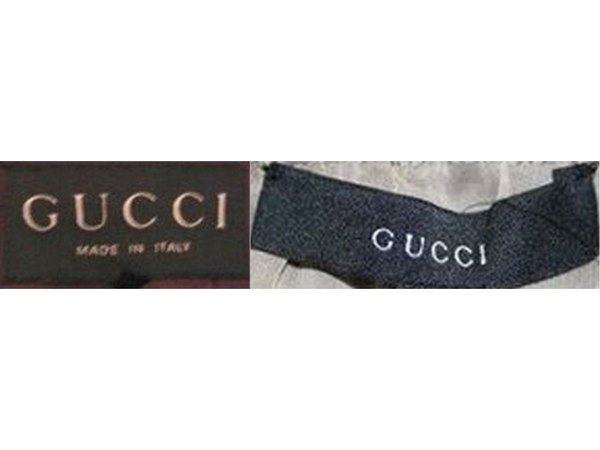
- The new Gucci logo was fully transitioned onto the tags, with the old crest logo being removed entirely
- This new logo was seen on simple black tags that were more rectangular
- All information other than the brand name and possibly location of manufacture was removed from neck tags and moved onto wash tags
How to spot it
A plain black rectangular tag with just the logo.
Value signal
Solid; 90s Gucci sells well — verify against counterfeits.
2000–2009
Fully Sewn-In Thin Tags
Much like the 90s, but tags became fully sewn in all the way round — nearly always thin rectangles, country of make included intermittently.
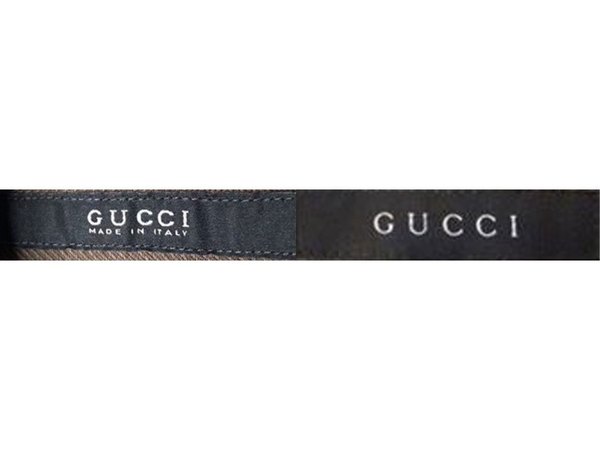
- Gucci tags in the 2000s remained very similar to those of the 1990s
- One point of difference is that tags at this time became fully sewn in all the way around
- Nearly all of them were thin rectangles
- Country of manufacture is included interchangeably
How to spot it
A thin black tag sewn in all the way around.
Value signal
Common; condition- and authentication-driven resale.
2010–2019
Beige Tag, Green Border
Recent tags are large beige rectangles with a Gucci-green border and red attaching thread, paired with long polyester wash tags.
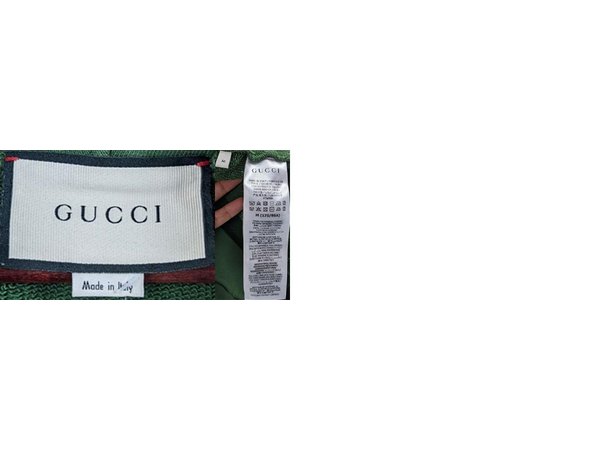
- The most recent Gucci tags are large beige rectangles with a Gucci green border and red thread used to attach them to the neck
- As you’ll see on the right, modern Gucci pieces use large, long polyester tags for wash tags which include most of the product information
- This tag is very different to ones from the last 20 years so should be easy to distinguish
How to spot it
A beige tag with a green border and red thread.
Value signal
Modern; priced on the piece, authentication still essential.