Levi's
The originator of the riveted waist overall. Levi's tags are among the most studied in vintage — the Red Tab, the capital-vs-lowercase 'E', and selvedge denim all anchor precise dating.
- Origin
- USA
- Founded
- 1853
- Category
- Denim
- Documented eras
- 3
How Levi's labels evolved over time. Match the markers below against the tag in hand to place a garment in its era.
1873–1936
Pre-Red-Tab Leather Patch
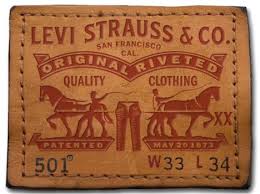
Before the Red Tab, Levi's waist overalls were identified solely by the two-horse leather patch stitched to the rear waistband.
No image- Genuine leather two-horse brand patch
- Cinch back and suspender buttons
- No Red Tab on the back pocket
- Exposed rivets, including the crotch rivet
How to spot it
A leather (not paper) patch and the complete absence of a Red Tab.
Value signal
Extremely rare; pre-1936 examples are collector-grade and almost never surface while thrifting.
1936–1971
The Big 'E' Red Tab
The Red Tab debuted in 1936 on the right back pocket. Through 1971 it read LEVI'S in all capitals — the famed 'Big E'.
No image- Red Tab with all-capital LEVI'S lettering
- Selvedge denim showing a clean self-edge in the outseam
- Hidden back-pocket rivets after 1937
- Lot numbers such as 501XX
How to spot it
Fold out the Red Tab — a capital E dates the piece to 1936–1971.
Value signal
Big E denim, especially selvedge 501s, is among the highest-value vintage on the market.
1971–present
The Lowercase 'e' Tab
In 1971 the Red Tab changed to a lowercase 'e' (LeVI'S). This coincides with the FTC care-labelling era, so fibre-content tags appear inside.
No image- Red Tab reads LeVI'S with a lowercase e
- Sewn-in care and fibre-content label
- Paper (jacron) waistband patch rather than leather
How to spot it
A lowercase e on the Red Tab.
Value signal
Plentiful; value depends on cut, wash, fabric, and condition rather than the tab itself.