Puma
Herzogenaurach's other sportswear house, founded by Rudolf Dassler. German-only text, 'hit union' woven tags, and the leaping-cat emblem date Puma across the post-war decades.

- Origin
- Germany
- Founded
- 1948
- Category
- Athletic & Streetwear
- Documented eras
- 7
How Puma labels evolved over time. Match the markers below against the tag in hand to place a garment in its era.
1960–1969
Thin Loop, German Text
Sixties Puma is rare — a thin fabric loop with a number size and the old cat emblem showing the puma's eye, almost always German-only text.

- Tags that are this old are rare to come across
- They are a relatively thin loop of fabric
- They have a number size on them
- And the old Puma emblem is used that shows the eye of the puma
- Puma from this era tends to have only German writing on it
How to spot it
A thin fabric loop, number sizing, German-only wording.
Value signal
Rare and collector-grade; seldom surfaces while thrifting.
1970–1979
Longer Printed Tags
Tags lengthened and were printed in black or blue, with a small separate tag carrying the number size.
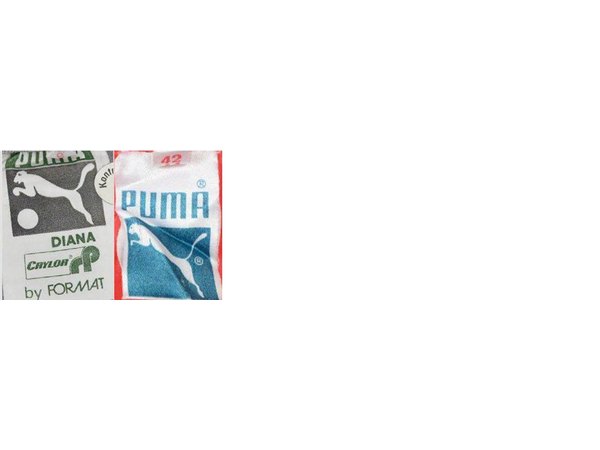
- The tags got slightly longer
- At this time, they were printed in either black or blue
- A small tag sewn in front of the main one would have a number size on it
How to spot it
A longer printed tag with a small size tag stitched in front.
Value signal
Strong vintage; 70s Puma holds collector interest.
1980–1989
Thick Woven Tags
The 1980s brought much thicker material with details woven rather than printed, mostly in German; the modern cat logo debuts here.
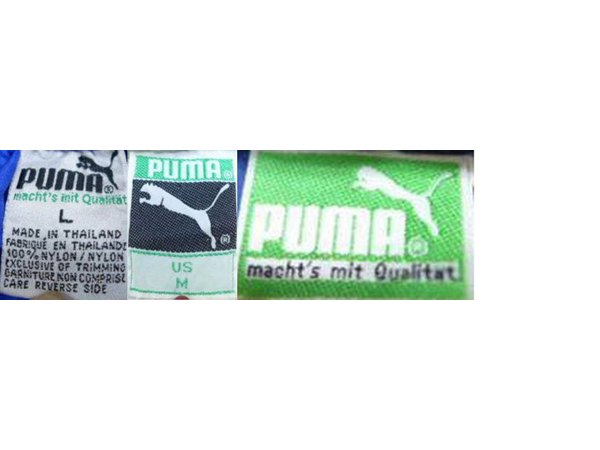
- The 1980s saw the tags use much thicker material, with the information sewn into the tag instead of being printed on many of the tags
- Most of these tags still used a lot of German
- Some of them reflected the wave logo of the 1980s
- Today’s commonly used logo was introduced on these tags
- They also started to include more information on the neck tags about manufacturing and composition
How to spot it
Thick woven tag, German wording, the modern leaping cat.
Value signal
Desirable; 80s Puma is a dependable reseller era.
1987–1993
Six-Country Printed Tags
A bridging design kept the thick material but added letter sizing; the printed variants carried six country sizes and stand out sharply from the norm.
- In the 1980s and 1990s the tags continued to be made from a thick material
- Letter sizing became more common on these tags
- Some tags did still use a printed design, and these would include 6 country sizes on them, and are very easily distinguishable from typical Puma tags
How to spot it
A printed tag listing six country sizes.
Value signal
Solid; the distinctive printed variant is a nice find.
1990–1999
'Hit Union' Silver Tags
Thick silver tags with woven-in text; many carry 'hit union' at the base, though the absence of it does not rule out vintage.
- These tags used a thick silver material, with the text sewn in
- Many of them had the term hit union on them, but it is likely that your Puma is still vintage if it looks like this but doesn’t have hit union at the bottom
How to spot it
A thick silver woven tag, often reading 'hit union'.
Value signal
Strong; 90s 'hit union' Puma is a recognised vintage marker.
1997–2003
Boxed Logo in Silver
A major redesign set the Puma logo inside a rectangle on a silver tag, with letter sizing to the right and extra detail on a neighbouring tag.
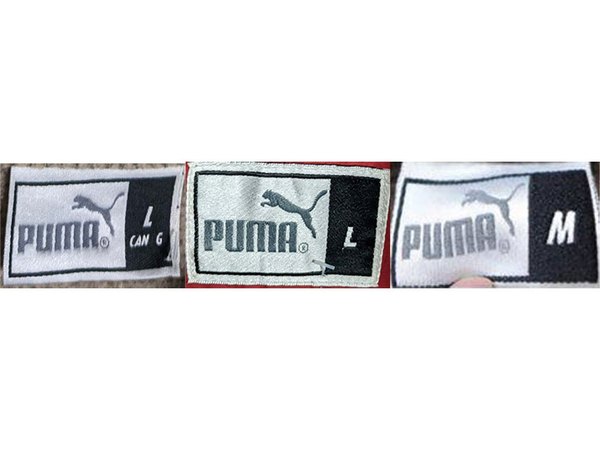
- The next tags were one of the biggest shifts in design up to this point and first appeared in the late 1990s
- The Puma logo is set within a silver tag, enclosed by a rectangle
- The letter sizing is included to the right, and sometimes has European lettering as well
- Extra manufacture and composition information would be included on a tag next to this one or sewn in at the waist
How to spot it
The Puma logo enclosed in a rectangle on a silver tag.
Value signal
Common; transitional and priced on the garment.
2010–2019
Bright Orange Tags
Modern tags are often (not always) bright orange with multi-country sizing; a printed website address is a dead giveaway of a non-vintage piece.
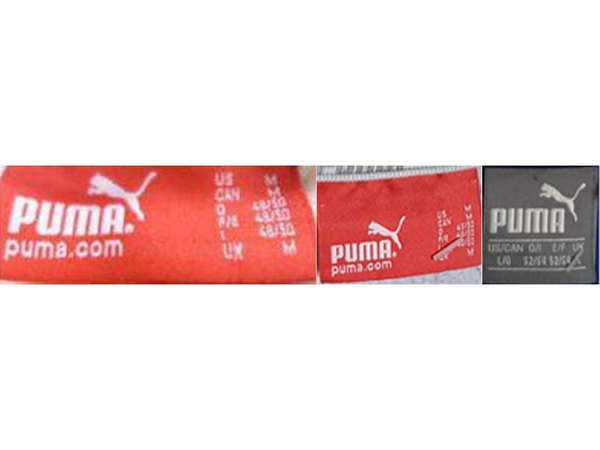
- The modern Puma tags are often (but not always) set on a bright orange tag
- They include sizing for multiple countries
- Sometimes they even have the Puma website on them, which is a dead giveaway that an item is not vintage
How to spot it
A bright orange tag — and a website URL means modern.
Value signal
Modern; no vintage premium.