Tultex
Virginia blank-activewear maker founded as the Pannill Knitting Company in 1926. Blue-and-white consistent-colour-scheme tags mark the mid-to-late 1980s; the white-rectangle with blue Tultex logo and border tracks the late 1980s–90s; the black-square logo variant is the mid-1990s identifier.

- Origin
- USA
- Founded
- 1926
- Category
- Blank Tag
- Documented eras
- 5
How Tultex labels evolved over time. Match the markers below against the tag in hand to place a garment in its era.
1980–1989
Mid to Late 1980s vintage Tultex tags
At this time tags used a consistent color and design scheme across variations Combining blue and white, the tags use block colors.

- At this time tags used a consistent color and design scheme across variations.
- Combining blue and white, the tags use block colors.
- The logo is always set within the blue.
- They include sizing by word.
- And have care information either on the front or back of the one tag.
- Many of these Tultex pieces were made in the USA.
How to spot it
At this time tags used a consistent color and design scheme across variations — confirms this label era.
Value signal
Good vintage demand; 1980s label detail is a key value driver.
1980–1989
Late 1980s to Early 1990s vintage Tultex tags
The tags became white rectangles with the logo in blue on them with an outer border Some of the tags had the care instructions and sizing all on the same piece of fabric, however it became more common for an extra polyester tag behind the main one to contain this information.
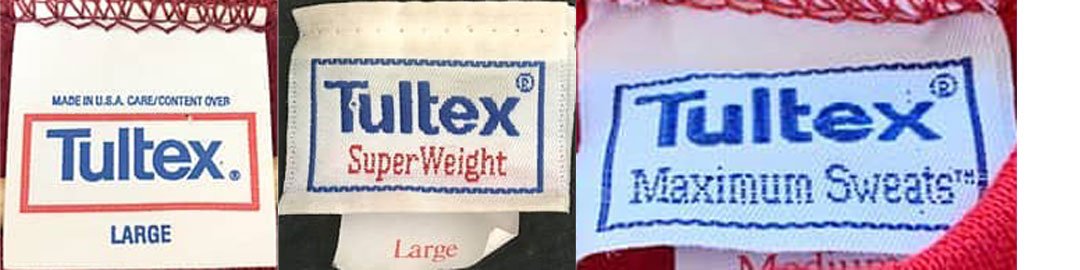
- The tags became white rectangles with the logo in blue on them with an outer border.
- Some of the tags had the care instructions and sizing all on the same piece of fabric, however it became more common for an extra polyester tag behind the main one to contain this information.
- They also started including references to the line of Tultex clothing, such as ‘Maximum Sweats’ and ‘SuperWeight’.
How to spot it
The tags became white rectangles with the logo in blue on them with an outer border — confirms this label era.
Value signal
Good vintage demand; 1980s label detail is a key value driver.
1990–1999
Early to Mid 1990s vintage Tultex tags
The tags remained the same shape and, in many cases, the same visual design However, a very noticeable change is the tags becoming a thin polyester with the information printed on instead of sewn in.
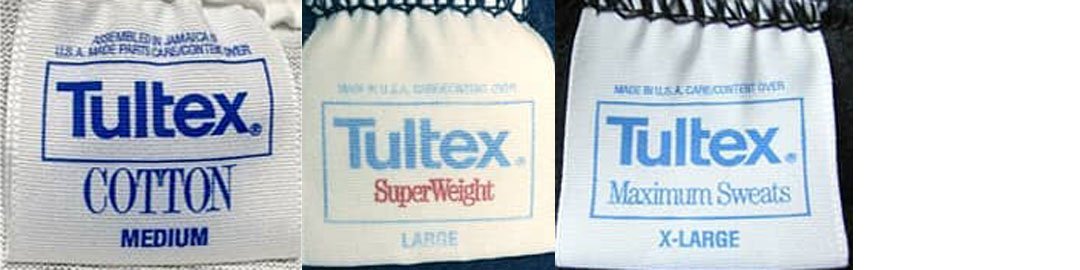
- The tags remained the same shape and, in many cases, the same visual design.
- However, a very noticeable change is the tags becoming a thin polyester with the information printed on instead of sewn in.
- These tags also included sizing information on the front and care information on the back.
How to spot it
The tags remained the same shape and, in many cases, the same visual design — confirms this label era.
Value signal
Moderate collector interest; condition and completeness determine value.
1990–1999
Mid 1990s vintage Tultex tags
The mid-1990s saw the debut of the new Tultex logo On these tags, it is white in a black square, sometimes accompanied by the product line.
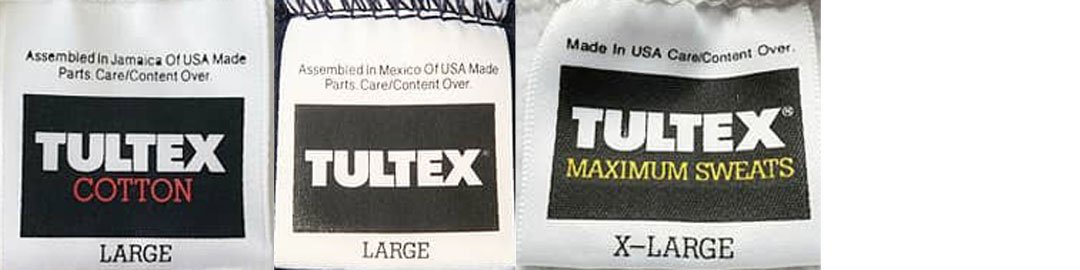
- The mid-1990s saw the debut of the new Tultex logo.
- On these tags, it is white in a black square, sometimes accompanied by the product line.
- It started to become more common for products to be partly assembled or sourced from outside the USA.
How to spot it
The mid-1990s saw the debut of the new Tultex logo — confirms this label era.
Value signal
Moderate collector interest; condition and completeness determine value.
1990–1999
Late 1990s to 2000s vintage Tultex tags
The logo remained the same into the 2000s, however, its design on tags changed slightly It became a black font on a white tag, with only the product line beneath it being set in a black box.
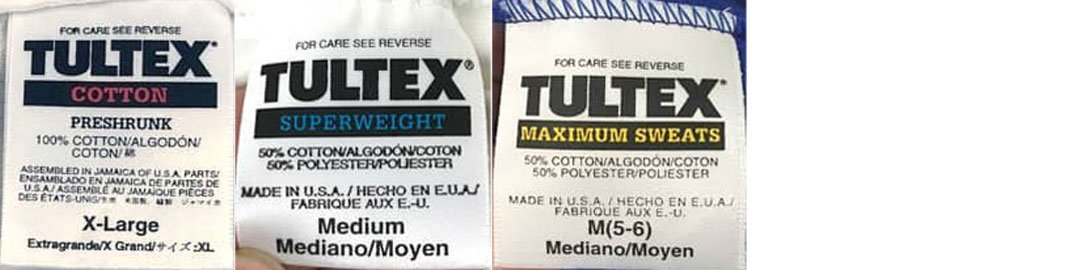
- The logo remained the same into the 2000s, however, its design on tags changed slightly.
- It became a black font on a white tag, with only the product line beneath it being set in a black box.
- These tags started to include a lot more information on the front such as country of manufacture, composition, and sizing in multiple languages.
How to spot it
The logo remained the same into the 2000s, however, its design on tags changed slightly — confirms this label era.
Value signal
Moderate collector interest; condition and completeness determine value.